Customer data management (CDM) is the ways in which businesses keep track of their customer information and survey their customer base in order to obtain feedback. CDM includes a range of software or cloud computing applications designed to give large organizations rapid and efficient access to customer data. Surveys and data can be centrally located and widely accessible within a company, as opposed to being warehoused in separate departments. CDM encompasses the collection, analysis, organizing, reporting and sharing of customer information throughout an organization. Businesses need a thorough understanding of their customers’ needs if they are to retain and increase their customer base. Efficient CDM solutions provide companies with the ability to deal instantly with customer issues and obtain immediate feedback. As a result, customer retention and customer satisfaction can show marked improvement. According to a study by Aberdeen Group, "above-average and best-in-class companies... attain greater than 20% annual improvement in retention rates, revenues, data accuracy and partner/customer satisfaction rates." == Customer data management and cloud computing == Cloud computing offers an attractive choice for CDM in many companies due to its accessibility and cost-effectiveness. Businesses can decide who, within their company, should have the ability to create, adjust, analyze or share customer information. In December 2010, 52% of Information Technology (IT) professionals worldwide were deploying, or planning to deploy, cloud computing; this percentage is far higher in many countries. == Background == Customer data management, as a term, was coined in the 1990s, pre-dating the alternative term enterprise feedback management (EFM). CDM was introduced as a software solution that would replace earlier disc-based or paper-based surveys and spreadsheet data. Initially, CDM solutions were marketed to businesses as software, which were specific to one company, and often to one department within that company. This was superseded by application service providers (ASPs) where software was hosted for end user organizations, thus avoiding the necessity for IT professionals to deploy and support software. However, ASPs with their single-tenancy architecture were, in turn, superseded by software as a service (SaaS), engineered for multi-tenancy. By 2007 SaaS applications, giving businesses on-demand access to their customer information, were rapidly gaining popularity compared with ASPs. Cloud computing now includes SaaS and many prominent CDM providers offer cloud-based applications to their clients. In recent years, there has been a push away from the term EFM, with many of those working in this area advocating the slightly updated use of CDM. The return to the term CDM is largely based on the greater need for clarity around the solutions offered by companies, and on the desire to retire terminology veering on techno-jargon that customers may have a hard time understanding.
Headway (app)
Headway, also known as the Headway App, is an educational technology (EdTech) product that provides short text and audio summaries of nonfiction books. The product was launched in 2019 by Anton Pavlovsky and is developed by Headway Inc, a global consumer tech company that operates in the lifelong learning space. == History == The Headway app was launched in January 2019, with the first version of the application released the same year. In 2021, Headway ranked first globally in downloads within the book summary application niche. In 2022, the application received the Golden Novum Design Award for product design. In 2023 and 2024, Headway appeared in several App Store editorial selections, including App of the Day in multiple countries, and received an Editors’ Choice label in the United States. In April 2025, the application was listed as a Webby Honoree in the Learning & Education category. The company has also launched the Headway Scholarship for Book Lovers. As of 2025, publicly available reporting notes that the Headway app has surpassed 50 million downloads and is among the Top 10 iOS applications by revenue in the Education category worldwide. == Products and features == The Headway app provides short-form summaries of nonfiction books in both text and audio formats. Content is produced by an in-house team of writers, editors, and voice actors. Features include highlighting and saving key insights, spaced repetition for knowledge retention, and offline access to downloaded summaries. The app is available on iOS, iPadOS, watchOS, Android, CarPlay, and Android Auto, and supports multiple languages. == Pricing == Headway operates on a subscription business model, with optional paid plans alongside free access. The company publicly provides its terms of use, privacy policy, subscription details, and AI usage policy on its official website. == Technology and integrations == Headway reports that its book summaries are written and edited manually, while artificial intelligence tools are used in limited supporting functions, such as experimental conversational features and selected marketing processes. == Adoption == According to figures released by the company, the app has exceeded 50 million downloads worldwide. Sensor Tower data indicates that Headway has been the most downloaded application in its niche since October 2020. In January 2025, the app claimed the #1 position in the Education category in both the United States and United Kingdom App Stores and remained among the Top 10 iOS applications globally by revenue within the Education category. == Awards == The Headway app has received several product-level distinctions. In 2023 and 2024, it appeared in multiple App Store editorial selections, including App of the Day features and an Editors’ Choice label in the United States. In 2025, the app was recognized as a Webby Honoree in the Learning & Education category. The product has also been featured in independent media roundups of notable educational applications.
MobileNet
MobileNet is a family of convolutional neural network (CNN) architectures designed for image classification, object detection, and other computer vision tasks. They are designed for small size, low latency, and low power consumption, making them suitable for on-device inference and edge computing on resource-constrained devices like mobile phones and embedded systems. They were originally designed to be run efficiently on mobile devices with TensorFlow Lite. The need for efficient deep learning models on mobile devices led researchers at Google to develop MobileNet. As of June 2025, the family has five versions, each improving upon the previous one in terms of performance and efficiency. == Features == === V1 === MobileNetV1 was published in April 2017. Its main architectural innovation was incorporation of depthwise separable convolutions. It was first developed by Laurent Sifre during an internship at Google Brain in 2013 as an architectural variation on AlexNet to improve convergence speed and model size. The depthwise separable convolution decomposes a single standard convolution into two convolutions: a depthwise convolution that filters each input channel independently and a pointwise convolution ( 1 × 1 {\displaystyle 1\times 1} convolution) that combines the outputs of the depthwise convolution. This factorization significantly reduces computational cost. The MobileNetV1 has two hyperparameters: a width multiplier α {\displaystyle \alpha } that controls the number of channels in each layer. Smaller values of α {\displaystyle \alpha } lead to smaller and faster models, but at the cost of reduced accuracy, and a resolution multiplier ρ {\displaystyle \rho } , which controls the input resolution of the images. Lower resolutions result in faster processing but potentially lower accuracy. === V2 === MobileNetV2 was published in March 2019. It uses inverted residual layers and linear bottlenecks. Inverted residuals modify the traditional residual block structure. Instead of compressing the input channels before the depthwise convolution, they expand them. This expansion is followed by a 1 × 1 {\displaystyle 1\times 1} depthwise convolution and then a 1 × 1 {\displaystyle 1\times 1} projection layer that reduces the number of channels back down. This inverted structure helps to maintain representational capacity by allowing the depthwise convolution to operate on a higher-dimensional feature space, thus preserving more information flow during the convolutional process. Linear bottlenecks removes the typical ReLU activation function in the projection layers. This was rationalized by arguing that that nonlinear activation loses information in lower-dimensional spaces, which is problematic when the number of channels is already small. === V3 === MobileNetV3 was published in 2019. The publication included MobileNetV3-Small, MobileNetV3-Large, and MobileNetEdgeTPU (optimized for Pixel 4). They were found by a form of neural architecture search (NAS) that takes mobile latency into account, to achieve good trade-off between accuracy and latency. It used piecewise-linear approximations of swish and sigmoid activation functions (which they called "h-swish" and "h-sigmoid"), squeeze-and-excitation modules, and the inverted bottlenecks of MobileNetV2. === V4 === MobileNetV4 was published in September 2024. The publication included a large number of architectures found by NAS. Inspired by Vision Transformers, the V4 series included multi-query attention. It also unified both inverted residual and inverted bottleneck from the V3 series with the "universal inverted bottleneck", which includes these two as special cases. === V5 === MobileNetV5's architecture was published shortly after the release of Gemma 3n in June 2025. While the announcement stated a technical report on MobileNetV5 would be available soon, this has not yet materialised. The network is 10 times larger than the largest V4 variant.
Domain adaptation
Domain adaptation is a field associated with machine learning and transfer learning. It addresses the challenge of training a model on one data distribution (the source domain) and applying it to a related but different data distribution (the target domain). A common example is spam filtering, where a model trained on emails from one user (source domain) is adapted to handle emails for another user with significantly different patterns (target domain). Domain adaptation techniques can also leverage unrelated data sources to improve learning. When multiple source distributions are involved, the problem extends to multi-source domain adaptation. Domain adaptation is a specific type of transfer learning. According to the taxonomy laid out by Pan and Yang (2010), it falls into the category of transductive transfer learning. In this setting, the source and target tasks are the same (e.g., both are object recognition), but the domains differ (different marginal distributions). This distinguishes it from inductive transfer learning (where labeled data is available for the target task) and unsupervised transfer learning (where labels are unavailable in both domains). == Classification of domain adaptation problems == Domain adaptation setups are classified in two different ways: according to the distribution shift between the domains, and according to the available data from the target domain. === Distribution shifts === Common distribution shifts are classified as follows: Covariate Shift occurs when the input distributions of the source and destination change, but the relationship between inputs and labels remains unchanged. The above-mentioned spam filtering example typically falls in this category. Namely, the distributions (patterns) of emails may differ between the domains, but emails labeled as spam in the one domain should similarly be labeled in another. Prior Shift (Label Shift) occurs when the label distribution differs between the source and target datasets, while the conditional distribution of features given labels remains the same. An example is a classifier of hair color in images from Italy (source domain) and Norway (target domain). The proportions of hair colors (labels) differ, but images within classes like blond and black-haired populations remain consistent across domains. A classifier for the Norway population can exploit this prior knowledge of class proportions to improve its estimates. Concept Shift (Conditional Shift) refers to changes in the relationship between features and labels, even if the input distribution remains the same. For instance, in medical diagnosis, the same symptoms (inputs) may indicate entirely different diseases (labels) in different populations (domains). === Data available during training === Domain adaptation problems typically assume that some data from the target domain is available during training. Problems can be classified according to the type of this available data: Unsupervised: Unlabeled data from the target domain is available, but no labeled data. In the above-mentioned example of spam filtering, this corresponds to the case where emails from the target domain (user) are available, but they are not labeled as spam. Domain adaptation methods can benefit from such unlabeled data, by comparing its distribution (patterns) with the labeled source domain data. Semi-supervised: Most data that is available from the target domain is unlabelled, but some labeled data is also available. In the above-mentioned case of spam filter design, this corresponds to the case that the target user has labeled some emails as being spam or not. Supervised: All data that is available from the target domain is labeled. In this case, domain adaptation reduces to refinement of the source domain predictor. In the above-mentioned example classification of hair-color from images, this could correspond to the refinement of a network already trained on a large dataset of labeled images from Italy, using newly available labeled images from Norway. == Formalization == Let X {\displaystyle X} be the input space (or description space) and let Y {\displaystyle Y} be the output space (or label space). The objective of a machine learning algorithm is to learn a mathematical model (a hypothesis) h : X → Y {\displaystyle h:X\to Y} able to attach a label from Y {\displaystyle Y} to an example from X {\displaystyle X} . This model is learned from a learning sample S = { ( x i , y i ) ∈ ( X × Y ) } i = 1 m {\displaystyle S=\{(x_{i},y_{i})\in (X\times Y)\}_{i=1}^{m}} . Usually in supervised learning (without domain adaptation), we suppose that the examples ( x i , y i ) ∈ S {\displaystyle (x_{i},y_{i})\in S} are drawn i.i.d. from a distribution D S {\displaystyle D_{S}} of support X × Y {\displaystyle X\times Y} (unknown and fixed). The objective is then to learn h {\displaystyle h} (from S {\displaystyle S} ) such that it commits the least error possible for labelling new examples coming from the distribution D S {\displaystyle D_{S}} . The main difference between supervised learning and domain adaptation is that in the latter situation we study two different (but related) distributions D S {\displaystyle D_{S}} and D T {\displaystyle D_{T}} on X × Y {\displaystyle X\times Y} . The domain adaptation task then consists of the transfer of knowledge from the source domain D S {\displaystyle D_{S}} to the target one D T {\displaystyle D_{T}} . The goal is then to learn h {\displaystyle h} (from labeled or unlabelled samples coming from the two domains) such that it commits as little error as possible on the target domain D T {\displaystyle D_{T}} . The major issue is the following: if a model is learned from a source domain, what is its capacity to correctly label data coming from the target domain? == Four algorithmic principles == === Reweighting algorithms === The objective is to reweight the source labeled sample such that it "looks like" the target sample (in terms of the error measure considered). === Iterative algorithms === A method for adapting consists in iteratively "auto-labeling" the target examples. The principle is simple: a model h {\displaystyle h} is learned from the labeled examples; h {\displaystyle h} automatically labels some target examples; a new model is learned from the new labeled examples. Note that there exist other iterative approaches, but they usually need target labeled examples. === Search of a common representation space === The goal is to find or construct a common representation space for the two domains. The objective is to obtain a space in which the domains are close to each other while keeping good performances on the source labeling task. This can be achieved through the use of Adversarial machine learning techniques where feature representations from samples in different domains are encouraged to be indistinguishable. === Hierarchical Bayesian Model === The goal is to construct a Bayesian hierarchical model p ( n ) {\displaystyle p(n)} , which is essentially a factorization model for counts n {\displaystyle n} , to derive domain-dependent latent representations allowing both domain-specific and globally shared latent factors. == Software packages == Several compilations of domain adaptation and transfer learning algorithms have been implemented over the past decades: SKADA (Python) ADAPT (Python) TLlib (Python) Domain-Adaptation-Toolbox (MATLAB)
Apprenticeship learning
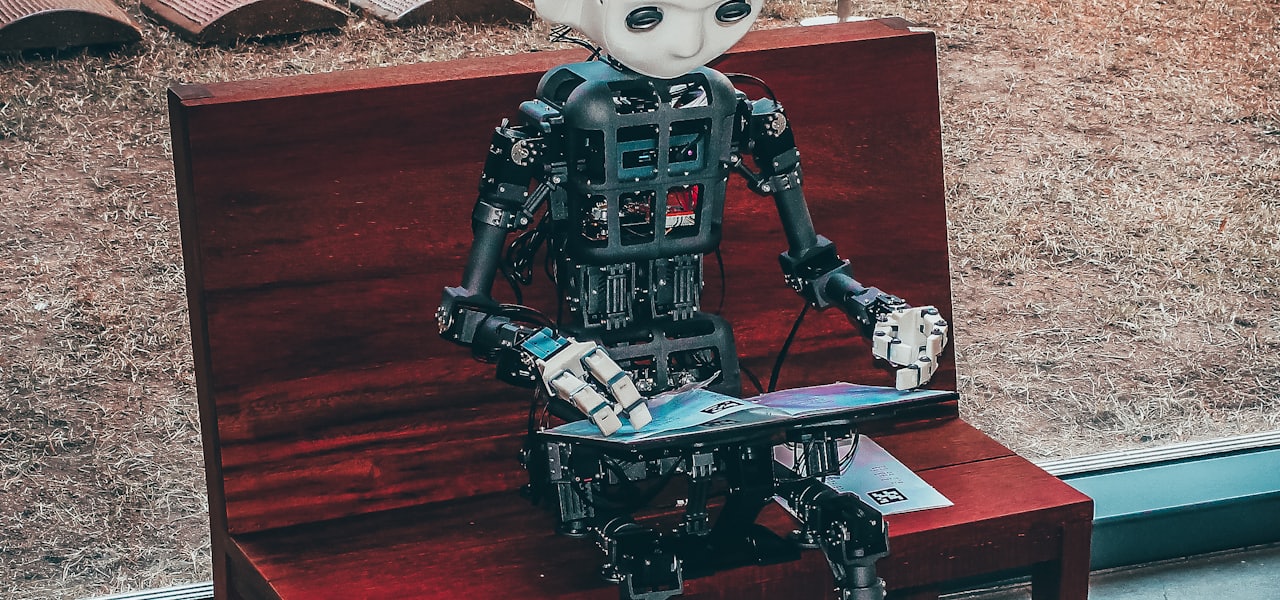
In artificial intelligence, apprenticeship learning (or learning from demonstration or imitation learning) is the process of learning by observing an expert. It can be viewed as a form of supervised learning, where the training dataset consists of task executions by a demonstration teacher. == Mapping function approach == Mapping methods try to mimic the expert by forming a direct mapping either from states to actions, or from states to reward values. For example, in 2002 researchers used such an approach to teach an AIBO robot basic soccer skills. === Inverse reinforcement learning approach === Inverse reinforcement learning (IRL) is the process of deriving a reward function from observed behavior. While ordinary "reinforcement learning" involves using rewards and punishments to learn behavior, in IRL the direction is reversed, and a robot observes a person's behavior to figure out what goal that behavior seems to be trying to achieve. The IRL problem can be defined as: Given 1) measurements of an agent's behaviour over time, in a variety of circumstances; 2) measurements of the sensory inputs to that agent; 3) a model of the physical environment (including the agent's body): Determine the reward function that the agent is optimizing. IRL researcher Stuart J. Russell proposes that IRL might be used to observe humans and attempt to codify their complex "ethical values", in an effort to create "ethical robots" that might someday know "not to cook your cat" without needing to be explicitly told. The scenario can be modeled as a "cooperative inverse reinforcement learning game", where a "person" player and a "robot" player cooperate to secure the person's implicit goals, despite these goals not being explicitly known by either the person nor the robot. In 2017, OpenAI and DeepMind applied deep learning to the cooperative inverse reinforcement learning in simple domains such as Atari games and straightforward robot tasks such as backflips. The human role was limited to answering queries from the robot as to which of two different actions were preferred. The researchers found evidence that the techniques may be economically scalable to modern systems. Apprenticeship via inverse reinforcement learning (AIRP) was developed by in 2004 Pieter Abbeel, Professor in Berkeley's EECS department, and Andrew Ng, Associate Professor in Stanford University's Computer Science Department. AIRP deals with "Markov decision process where we are not explicitly given a reward function, but where instead we can observe an expert demonstrating the task that we want to learn to perform". AIRP has been used to model reward functions of highly dynamic scenarios where there is no obvious reward function intuitively. Take the task of driving for example, there are many different objectives working simultaneously - such as maintaining safe following distance, a good speed, not changing lanes too often, etc. This task, may seem easy at first glance, but a trivial reward function may not converge to the policy wanted. One domain where AIRP has been used extensively is helicopter control. While simple trajectories can be intuitively derived, complicated tasks like aerobatics for shows has been successful. These include aerobatic maneuvers like - in-place flips, in-place rolls, loops, hurricanes and even auto-rotation landings. This work was developed by Pieter Abbeel, Adam Coates, and Andrew Ng - "Autonomous Helicopter Aerobatics through Apprenticeship Learning" === System model approach === System models try to mimic the expert by modeling world dynamics. == Plan approach == The system learns rules to associate preconditions and postconditions with each action. In one 1994 demonstration, a humanoid learns a generalized plan from only two demonstrations of a repetitive ball collection task. == Example == Learning from demonstration is often explained from a perspective that the working Robot-control-system is available and the human-demonstrator is using it. And indeed, if the software works, the Human operator takes the robot-arm, makes a move with it, and the robot will reproduce the action later. For example, he teaches the robot-arm how to put a cup under a coffeemaker and press the start-button. In the replay phase, the robot is imitating this behavior 1:1. But that is not how the system works internally; it is only what the audience can observe. In reality, Learning from demonstration is much more complex. One of the first works on learning by robot apprentices (anthropomorphic robots learning by imitation) was Adrian Stoica's PhD thesis in 1995. In 1997, robotics expert Stefan Schaal was working on the Sarcos robot-arm. The goal was simple: solve the pendulum swingup task. The robot itself can execute a movement, and as a result, the pendulum is moving. The problem is, that it is unclear what actions will result into which movement. It is an Optimal control-problem which can be described with mathematical formulas but is hard to solve. The idea from Schaal was, not to use a Brute-force solver but record the movements of a human-demonstration. The angle of the pendulum is logged over three seconds at the y-axis. This results into a diagram which produces a pattern. In computer animation, the principle is called spline animation. That means, on the x-axis the time is given, for example 0.5 seconds, 1.0 seconds, 1.5 seconds, while on the y-axis is the variable given. In most cases it's the position of an object. In the inverted pendulum it is the angle. The overall task consists of two parts: recording the angle over time and reproducing the recorded motion. The reproducing step is surprisingly simple. As an input we know, in which time step which angle the pendulum must have. Bringing the system to a state is called “Tracking control” or PID control. That means, we have a trajectory over time, and must find control actions to map the system to this trajectory. Other authors call the principle “steering behavior”, because the aim is to bring a robot to a given line.
Confidential computing
Confidential computing is a security and privacy-enhancing computational technique focused on protecting data in use. Confidential computing can be used in conjunction with storage and network encryption, which protect data at rest and data in transit respectively. It is designed to address software, protocol, cryptographic, and basic physical and supply-chain attacks, although some critics have demonstrated architectural and side-channel attacks effective against the technology. The technology protects data in use by performing computations in a hardware-based trusted execution environment (TEE). Confidential data is released to the TEE only once it is assessed to be trustworthy. Different types of confidential computing define the level of data isolation used, whether virtual machine, application, or function, and the technology can be deployed in on-premise data centers, edge locations, or the public cloud. It is often compared with other privacy-enhancing computational techniques such as fully homomorphic encryption, secure multi-party computation, and Trusted Computing. Confidential computing is promoted by the Confidential Computing Consortium (CCC) industry group, whose membership includes major providers of the technology. == Properties == Trusted execution environments (TEEs) "prevent unauthorized access or modification of applications and data while they are in use, thereby increasing the security level of organizations that manage sensitive and regulated data". Trusted execution environments can be instantiated on a computer's processing components such as a central processing unit (CPU) or a graphics processing unit (GPU). In their various implementations, TEEs can provide different levels of isolation including virtual machine, individual application, or compute functions. Typically, data in use in a computer's compute components and memory exists in a decrypted state and can be vulnerable to examination or tampering by unauthorized software or administrators. According to the CCC, confidential computing protects data in use through a minimum of three properties: Data confidentiality: "Unauthorized entities cannot view data while it is in use within the TEE". Data integrity: "Unauthorized entities cannot add, remove, or alter data while it is in use within the TEE". Code integrity: "Unauthorized entities cannot add, remove, or alter code executing in the TEE". In addition to trusted execution environments, remote cryptographic attestation is an essential part of confidential computing. The attestation process assesses the trustworthiness of a system and helps ensure that confidential data is released to a TEE only after it presents verifiable evidence that it is genuine and operating with an acceptable security posture. It allows the verifying party to assess the trustworthiness of a confidential computing environment through an "authentic, accurate, and timely report about the software and data state" of that environment. "Hardware-based attestation schemes rely on a trusted hardware component and associated firmware to execute attestation routines in a secure environment". Without attestation, a compromised system could deceive others into trusting it, claim it is running certain software in a TEE, and potentially compromise the confidentiality or integrity of the data being processed or the integrity of the trusted code. == Technical approaches == Technical approaches to confidential computing may vary in which software, infrastructure and administrator elements are allowed to access confidential data. The "trust boundary," which circumscribes a trusted computing base (TCB), defines which elements have the potential to access confidential data, whether they are acting benignly or maliciously. Confidential computing implementations enforce the defined trust boundary at a specific level of data isolation. The three main types of confidential computing are: Virtual machine isolation Application isolation, also known as process isolation Function isolation, also known as library isolation Virtual machine isolation removes the elements controlled by the computer infrastructure or cloud provider, but allows potential data access by elements inside a virtual machine running on the infrastructure. Application or process isolation permits data access only by authorized software applications or processes. Function or library isolation is designed to permit data access only by authorized subroutines or modules within a larger application, blocking access by any other system element, including unauthorized code in the larger application. == Threat model == As confidential computing is concerned with the protection of data in use, only certain threat models can be addressed by this technique. Other types of attacks are better addressed by other privacy-enhancing technologies. === In scope === The following threat vectors are generally considered in scope for confidential computing: Software attacks: including attacks on the host’s software and firmware. This may include the operating system, hypervisor, BIOS, other software and workloads. Protocol attacks: including "attacks on protocols associated with attestation as well as workload and data transport". This includes vulnerabilities in the "provisioning or placement of the workload" or data that could cause a compromise. Cryptographic attacks: including "vulnerabilities found in ciphers and algorithms due to a number of factors, including mathematical breakthroughs, availability of computing power and new computing approaches such as quantum computing". The CCC notes several caveats in this threat vector, including relative difficulty of upgrading cryptographic algorithms in hardware and recommendations that software and firmware be kept up-to-date. A multi-faceted, defense-in-depth strategy is recommended as a best practice. Basic physical attacks: including cold boot attacks, bus and cache snooping and plugging attack devices into an existing port, such as a PCI Express slot or USB port. Basic upstream supply-chain attacks: including attacks that would compromise TEEs through changes such as added debugging ports. The degree and mechanism of protection against these threats varies with specific confidential computing implementations. === Out of scope === Threats generally defined as out of scope for confidential computing include: Sophisticated physical attacks: including physical attacks that "require long-term and/or invasive access to hardware" such as chip scraping techniques and electron microscope probes. Upstream hardware supply-chain attacks: including attacks on the CPU manufacturing process, CPU supply chain in key injection/generation during manufacture. Attacks on components of a host system that are not directly providing the capabilities of the trusted execution environment are also generally out-of-scope. Availability attacks: confidential computing is designed to protect the confidentiality and integrity of protected data and code. It does not address availability attacks such as Denial of Service or Distributed Denial of Service attacks. == Use cases == Confidential computing can be deployed in the public cloud, on-premise data centers, or distributed "edge" locations, including network nodes, branch offices, industrial systems and others. === Data privacy and security === Confidential computing protects the confidentiality and integrity of data and code from the infrastructure provider, unauthorized or malicious software and system administrators, and other cloud tenants, which may be a concern for organizations seeking control over sensitive or regulated data. The additional security capabilities offered by confidential computing can help accelerate the transition of more sensitive workloads to the cloud or edge locations. === Multi-party analytics === Confidential computing can enable multiple parties to engage in joint analysis using confidential or regulated data inside a TEE while preserving privacy and regulatory compliance. In this case, all parties benefit from the shared analysis, but no party's sensitive data or confidential code is exposed to the other parties or system host. Examples include multiple healthcare organizations contributing data to medical research, or multiple banks collaborating to identify financial fraud or money laundering. Oxford University researchers proposed the alternative paradigm called "Confidential Remote Computing" (CRC), which supports confidential operations in Trusted Execution Environments across endpoint computers considering multiple stakeholders as mutually distrustful data, algorithm and hardware providers. === Confidential generative AI === Confidential computing technologies can be applied to various stages of a generative AI deployments to help increase data or model privacy, security, and regulatory compliance. TEEs and remote attestation can protect the integrity of data during AI model training, keep
Intelligent agent
In artificial intelligence, an intelligent agent is an entity that perceives its environment, takes actions autonomously to achieve goals, and may improve its performance through machine learning or by acquiring knowledge. AI textbooks define artificial intelligence as the "study and design of intelligent agents," emphasizing that goal-directed behavior is central to intelligence. A specialized subset of intelligent agents, agentic AI (also known as an AI agent or simply agent), expands this concept by proactively pursuing goals, making decisions, and taking actions over extended periods. Intelligent agents can range from simple to highly complex. A basic thermostat or control system is considered an intelligent agent, as is a human being, or any other system that meets the same criteria—such as a firm, a state, or a biome. Intelligent agents operate based on an objective function, which encapsulates their goals. They are designed to create and execute plans that maximize the expected value of this function upon completion. For example, a reinforcement learning agent has a reward function, which allows programmers to shape its desired behavior. Similarly, an evolutionary algorithm's behavior is guided by a fitness function. Intelligent agents in artificial intelligence are closely related to agents in economics, and versions of the intelligent agent paradigm are studied in cognitive science, ethics, and the philosophy of practical reason, as well as in many interdisciplinary socio-cognitive modeling and computer social simulations. Intelligent agents are often described schematically as abstract functional systems similar to computer programs . To distinguish theoretical models from real-world implementations, abstract descriptions of intelligent agents are called abstract intelligent agents. Intelligent agents are also closely related to software agents—autonomous computer programs that carry out tasks on behalf of users. They are also referred to using a term borrowed from economics: a "rational agent". == Intelligent agents as the foundation of AI == The concept of intelligent agents provides a foundational lens through which to define and understand artificial intelligence. For instance, the influential textbook Artificial Intelligence: A Modern Approach (Russell & Norvig) describes: Agent: Anything that perceives its environment (using sensors) and acts upon it (using actuators). E.g., a robot with cameras and wheels, or a software program that reads data and makes recommendations. Rational Agent: An agent that strives to achieve the best possible outcome based on its knowledge and past experiences. "Best" is defined by a performance measure – a way of evaluating how well the agent is doing. Artificial Intelligence (as a field): The study and creation of these rational agents. Other researchers and definitions build upon this foundation. Padgham & Winikoff emphasize that intelligent agents should react to changes in their environment in a timely way, proactively pursue goals, and be flexible and robust (able to handle unexpected situations). Some also suggest that ideal agents should be "rational" in the economic sense (making optimal choices) and capable of complex reasoning, like having beliefs, desires, and intentions (BDI model). Kaplan and Haenlein offer a similar definition, focusing on a system's ability to understand external data, learn from that data, and use what is learned to achieve goals through flexible adaptation. Defining AI in terms of intelligent agents offers several key advantages: Avoids Philosophical Debates: It sidesteps arguments about whether AI is "truly" intelligent or conscious, like those raised by the Turing test or Searle's Chinese Room. It focuses on behavior and goal achievement, not on replicating human thought. Objective Testing: It provides a clear, scientific way to evaluate AI systems. Researchers can compare different approaches by measuring how well they maximize a specific "goal function" (or objective function). This allows for direct comparison and combination of techniques. Interdisciplinary Communication: It creates a common language for AI researchers to collaborate with other fields like mathematical optimization and economics, which also use concepts like "goals" and "rational agents." == Objective function == An objective function (or goal function) specifies the goals of an intelligent agent. An agent is deemed more intelligent if it consistently selects actions that yield outcomes better aligned with its objective function. In effect, the objective function serves as a measure of success. The objective function may be: Simple: For example, in a game of Go, the objective function might assign a value of 1 for a win and 0 for a loss. Complex: It might require the agent to evaluate and learn from past actions, adapting its behavior based on patterns that have proven effective. The objective function encapsulates all of the goals the agent is designed to achieve. For rational agents, it also incorporates the trade-offs between potentially conflicting goals. For instance, a self-driving car's objective function might balance factors such as safety, speed, and passenger comfort. Different terms are used to describe this concept, depending on the context. These include: Utility function: Often used in economics and decision theory, representing the desirability of a state. Objective function: A general term used in optimization. Loss function: Typically used in machine learning, where the goal is to minimize the loss (error). Reward Function: Used in reinforcement learning. Fitness Function: Used in evolutionary systems. Goals, and therefore the objective function, can be: Explicitly defined: Programmed directly into the agent. Induced: Learned or evolved over time. In reinforcement learning, a "reward function" provides feedback, encouraging desired behaviors and discouraging undesirable ones. The agent learns to maximize its cumulative reward. In evolutionary systems, a "fitness function" determines which agents are more likely to reproduce. This is analogous to natural selection, where organisms evolve to maximize their chances of survival and reproduction. Some AI systems, such as nearest-neighbor, reason by analogy rather than being explicitly goal-driven. However, even these systems can have goals implicitly defined within their training data. Such systems can still be benchmarked by framing the non-goal system as one whose "goal" is to accomplish its narrow classification task. Systems not traditionally considered agents, like knowledge-representation systems, are sometimes included in the paradigm by framing them as agents with a goal of, for example, answering questions accurately. Here, the concept of an "action" is extended to encompass the "act" of providing an answer. As a further extension, mimicry-driven systems can be framed as agents optimizing a "goal function" based on how closely the agent mimics the desired behavior. In generative adversarial networks (GANs) of the 2010s, an "encoder"/"generator" component attempts to mimic and improvise human text composition. The generator tries to maximize a function representing how well it can fool an antagonistic "predictor"/"discriminator" component. While symbolic AI systems often use an explicit goal function, the paradigm also applies to neural networks and evolutionary computing. Reinforcement learning can generate intelligent agents that appear to act in ways intended to maximize a "reward function". Sometimes, instead of setting the reward function directly equal to the desired benchmark evaluation function, machine learning programmers use reward shaping to initially give the machine rewards for incremental progress. Yann LeCun stated in 2018, "Most of the learning algorithms that people have come up with essentially consist of minimizing some objective function." AlphaZero chess had a simple objective function: +1 point for each win, and -1 point for each loss. A self-driving car's objective function would be more complex. Evolutionary computing can evolve intelligent agents that appear to act in ways intended to maximize a "fitness function" influencing how many descendants each agent is allowed to leave. The mathematical formalism of AIXI was proposed as a maximally intelligent agent in this paradigm. However, AIXI is uncomputable. In the real world, an intelligent agent is constrained by finite time and hardware resources, and scientists compete to produce algorithms that achieve progressively higher scores on benchmark tests with existing hardware. == Agent function == An intelligent agent's behavior can be described mathematically by an agent function. This function determines what the agent does based on what it has seen. A percept refers to the agent's sensory inputs at a single point in time. For example, a self-driving car's percepts might include camera images, lidar data, GPS coordinates, and speed r